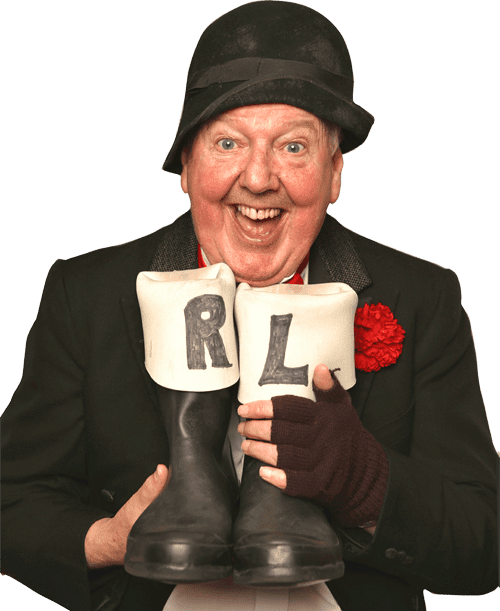

The World Cup currently taking place on the North American continent reminded Jimmy Cricket of “the forgotten coach”.
And he tells the story in his latest Lancashire Evening Post newspaper column about Englishman George Raynor, who holds a special place in Swedish football.
Here is Jimmy’s column:
My memory when the World Cup is on usually goes back to 1958 when the finals were held in Sweden.
I was just 13, television sets were in short supply in Belfast and word had filtered through that Northern Ireland had got to the quarter-finals against all the odds.
On the actual day of the final, our neighbours – the Gough family – kindly opened their front door and let the whole street in to watch their tiny black and white tele in the corner.
Oh, the innocence of it all… Brazil beat Sweden 5-2 and a 17-year-old Pele mesmerised us all as he dribbled rings around the Swedish defence and got two of the goals.
It all came back to me recently when I watched a biopic of his life on Amazon Prime.
Yorkshire accent at Swedish press conference
But there’s more… something else in that movie caught my attention.
In a scene featuring the pre-match press conference, the Swedish manager started answering questions to the gathered journalists and – wait for this – he was answering them with a Yorkshire accent.
This intrigued me so I grabbed my iPhone and googled him, and it turned out to be an amazing story.
George Raynor was born in Hoyland Common near Barnsley in 1907 and as a professional footballer played for five different league clubs.
While working as a training instructor in Baghdad during the Second World War, he cobbled together an international team.
This brought him to the attention of the Secretary of the Football Association – Sir Stanley Rous, who recommended him to the Swedish FA.
George’s self-taught coaching skills and flair for man management turned the Swedish national team into a force to be reckoned with and they went on to win the 1948 Olympic Games.
Lenin’s statue
In 1953 they took on the famous Hungary team of Puskas and Hidegkuti in Budapest.
George is reputed to have said before the match: “If we win, I’ll climb up Lenin’s statue and paint his moustache red!”
In the event, he pulled off an astonishing 2-2 draw and attributed this to man-marking Hidegkuti.
Knowing that England were about to play Hungry three weeks later at Wembley, George passed on his tactical knowledge to the England management.
Alas, his advice went unheeded and England lost 6-3 to the Magic Magyars.
If you fast forward to when England did actually win the World Cup final by defeating West Germany in 1966 at Wembley, one of the contributory factors was the fact that the-then England manager, Sir Alf Ramsey, got the great Bobby Charlton to man mark the German’s star player – Frans Beckenbaur – so George knew his onions after all.
Subsidise his wages
In a glaring exposition of the highs and lows of football management, Geoge Raynor’s first job after leading Sweden to the 1958 World Cup final (they lost 5-2 to Brazil) was as a coach at Skegness Town FC.
To subsidise his wages, he worked at the nearby Butlin’s holiday camp as a storeman.
His burning desire was always to manage the England national team and in 1960 he made a compelling case for it in a book he wrote called Football Ambassador at Large.
Unfortunately, the powers that be in the English FA took his criticism to heart and he never did get that call.
He can of course take comfort from the fact that the King of Sweden gave him a Knighthood.
And he will be forever remembered by the Swedish people for taking their country to the final of the World Cup… Bra gjort George!
Leave a Reply